The Test
The Great Pyramid contains approximately 2.3 million blocks of stone. It was built in approximately twenty years. That is 315 finished blocks per day, every day, for 7,300 days.
Every theory of how the pyramid was built must answer one question: can your method achieve and sustain a throughput of 315 blocks per day?
Not peak throughput. Not theoretical throughput. Sustained, average, system-wide throughput — across twenty years of weather, maintenance, holidays, the annual Nile inundation, tool breakage, injuries, and the thousand logistical failures that plague any construction project.
What follows is a survey of the major proposals. Each theory is presented on its own terms, in its strongest form, by its best advocates. Then each one meets the arithmetic.
Some scholars argue the pyramid was built in as few as ten years. Others allow up to twenty-seven. The button below each theory lets you test it against all three timelines. The number changes. The problem does not.
2,300,000 ÷ 7,300 = 315
The Theories
Ramp Theories
The mainstream consensus — external ramps, internal spiral ramps, and combination approaches
This is the conventional explanation, and it comes in several versions. The simplest proposes a long, straight external ramp running from ground level to the working course of the pyramid. As the pyramid rose, the ramp grew longer and steeper. More sophisticated versions propose a ramp that spiraled around the exterior of the pyramid, reducing the overall length.
The most compelling modern variant comes from French architect Jean-Pierre Houdin, who proposed in 2007 that the ramp was internal — a mile-long corkscrew passage built inside the pyramid walls themselves. Houdin's theory is elegant and explains why no external ramp debris has ever been found at Giza. A straight external ramp, by contrast, would have required almost as much material as the pyramid itself.
Ramp theories are the standard model of Egyptology. They appear in textbooks, documentaries, and museum exhibits. They have the weight of institutional support behind them.
The 315 test: A ramp — any ramp — is a single-lane bottleneck. One crew is placing one block at the top while hundreds of blocks queue on the ramp below. Even Houdin's internal ramp, the best version of this theory, cannot explain how 315 separate blocks completed the full journey from quarry face to final placement in a single working day. The ramp is real. The throughput is not.
A ramp is a queue. No queue clears 233 blocks per day for 27 years.
Sledge and Water Lubrication
The transport mechanism — supported by a 2014 University of Amsterdam study and tomb paintings at Djehutihotep
A painting in the tomb of Djehutihotep, dating to approximately 1900 BC, shows a large statue being dragged on a sledge while a worker pours water onto the sand in front of it. In 2014, researchers at the University of Amsterdam demonstrated experimentally that wetting desert sand reduces friction by as much as fifty percent, making it far easier to drag heavy objects across the surface.
This is not a complete theory of pyramid construction — it is a transport mechanism. It explains how blocks moved horizontally across the plateau. It is often paired with one of the ramp theories to explain vertical movement.
The physics are sound. The Egyptians almost certainly used wet sand lubrication for heavy transport. The tomb painting and the laboratory results are credible evidence.
The 315 test: Wet sand lubrication solves the friction problem. It does not solve the throughput problem. Even if every sledge moves twice as fast, you still need 315 blocks to complete the full cycle — quarry, cut, transport, lift, place — every single day. The improvement is real. The gap remains.
Faster sledges do not create more sledges. The bottleneck is parallelism, not speed.
Geopolymer Concrete (Cast Stone)
Joseph Davidovits — French materials scientist, founder of the Geopolymer Institute
Professor Davidovits has proposed, with decades of laboratory work behind him, that the pyramid blocks were not quarried at all. Instead, he argues, the Egyptians dissolved local limestone in water with natron (a naturally occurring sodium compound), mixed it with aggregate, and poured the resulting slurry into molds directly on the pyramid. The blocks were cast in place, like concrete.
This is a serious scientific proposal. Davidovits is a respected chemist. He has produced geopolymer limestone in laboratory conditions that is visually and chemically similar to the Giza limestone. Some peer-reviewed studies have found microstructural evidence consistent with reconstituted stone in pyramid blocks.
The theory eliminates the transport problem entirely. If the blocks were cast on-site, there are no sledges, no ramps, and no quarry-to-pyramid logistics chain. It is the most elegant solution to the construction problem that conventional science has produced.
The 315 test: Casting eliminates transport, but it does not eliminate throughput. You still need 315 molds filled, set, cured, and stripped per day. You need millions of tons of aggregate carried to the working face. You need water — enormous quantities of water — in a desert. The bottleneck changes shape, but it does not disappear. And mainstream geology has not accepted that the Giza blocks are reconstituted. The core samples still look, to most geologists, like quarried nummulitic limestone.
Eliminating transport changes the bottleneck. It does not eliminate it. 233 pours per day still requires industrial-scale parallelism.
Hydraulic Lift Systems
Xavier Landreau and colleagues — proposed in a 2024 PLOS ONE study of the Step Pyramid at Saqqara
In August 2024, a research team led by Xavier Landreau published a study proposing that the Step Pyramid of Djoser at Saqqara was built using a hydraulic lift mechanism. In their model, water from a surrounding moat was channeled into large shafts inside the pyramid. A massive wooden float inside the shaft rose with the water level, lifting stone blocks on an attached platform.
The theory is based on physical features of the Step Pyramid that have no other obvious explanation — large internal shafts, granite chambers with removable plugs, and evidence of water channels. It is a peer-reviewed proposal published in a reputable journal.
It is important to note that this theory was developed for the Step Pyramid, not the Great Pyramid. The Step Pyramid is roughly 62 meters tall. The Great Pyramid is 146 meters tall and contains approximately forty times the volume of stone.
The 315 test: A hydraulic lift is a single vertical channel. Even if it works perfectly, it is one elevator serving the entire project. The Step Pyramid's scale might accommodate it. The Great Pyramid's throughput requirement — 315 blocks per day to a working face that eventually reaches 146 meters — would require dozens of such lifts operating simultaneously. The mechanism is interesting. The scale is the problem.
One lift, one shaft, one block at a time. The Step Pyramid has 330,000 blocks. The Great Pyramid has 2.3 million.
Alien Intervention
Erich von Däniken, Zecharia Sitchin, and the Ancient Aliens tradition
In 1968, Swiss author Erich von Däniken published Chariots of the Gods, proposing that ancient monuments including the Great Pyramid were built with the assistance of extraterrestrial visitors. The book sold over 60 million copies and launched an industry. Zecharia Sitchin extended the idea with his Earth Chronicles series, proposing a detailed mythology of alien visitors called the Anunnaki.
The television series Ancient Aliens, which premiered in 2010, brought these ideas to a mass audience. In 2020, Elon Musk tweeted that aliens built the pyramids — a claim that generated millions of impressions and a formal response from Egypt's Ministry of International Co-operation.
The alien intervention hypothesis exists because the engineering problem is real. The people asking the question are not wrong to ask it. The Great Pyramid is an extraordinary achievement, and the gap between the available tools and the demonstrated result is genuinely difficult to explain.
The 315 test: This theory answers the throughput problem by changing the technology. If the builders had advanced machinery, 315 blocks per day is achievable. But the theory offers no specifics — no mechanism, no engineering, no operational model. It is an answer without arithmetic. It identifies the right problem and then stops where the math should start.
Advanced technology is asserted but never specified. No mechanism. No fleet. No operational math.
Lost Advanced Civilization
Graham Hancock — British journalist and author of Fingerprints of the Gods
Graham Hancock proposes that a technologically advanced human civilization existed before the end of the last Ice Age, approximately 12,000 years ago, and was destroyed by a global cataclysm. Survivors of this civilization, Hancock argues, carried their knowledge to Egypt and other ancient cultures, where it was used to build monuments that should have been impossible for Bronze Age societies.
Hancock does not claim aliens built the pyramids. He claims humans did — but humans with knowledge and technology that predates the civilization we think we know. His work draws on geological evidence for catastrophic flooding at the end of the Younger Dryas period, astronomical alignments in ancient monuments, and the sophistication of the earliest Egyptian construction.
The Netflix series Ancient Apocalypse brought Hancock's ideas to a global audience in 2022. His work is controversial among academic archaeologists but has a large and engaged readership.
The 315 test: Like the alien hypothesis, the lost civilization theory answers the throughput problem by invoking superior technology. But it is similarly unspecific. If the lost civilization had advanced construction methods, what were they? What machines, what materials, what operational model closes the gap? The theory moves the mystery backward in time without solving the engineering problem. The pyramid still needs 315 blocks per day. Somebody — whether in 2500 BC or 10,000 BC — still has to explain how.
Moving the question to 10,000 BC does not answer it. The throughput problem is still 315.
And All the Others
These are the major proposals, but they are not all of them. Lever-and-pivot systems. Counterweight machines. Internal water channels. Kite-assisted lifting. Acoustic levitation. The Great Pyramid has attracted more construction theories than any structure in human history.
We cannot examine every one. But we do not need to. Every theory, regardless of its mechanism, must answer the same question.
every day, for twenty years?
If it can, show the math. If it cannot, the pyramid is still unexplained.
Every theory on this page was presented in its strongest form, by its best advocates, with its best evidence. None of them were dismissed. All of them were measured.
The only thing that changed between them was the ruler.
The arithmetic is not a theory. It is a division problem. And the division problem does not care which answer you prefer.
The Theory That Survives
Twenty Years in Egypt
D.H. Trout — historical science fiction built on real engineering constraints
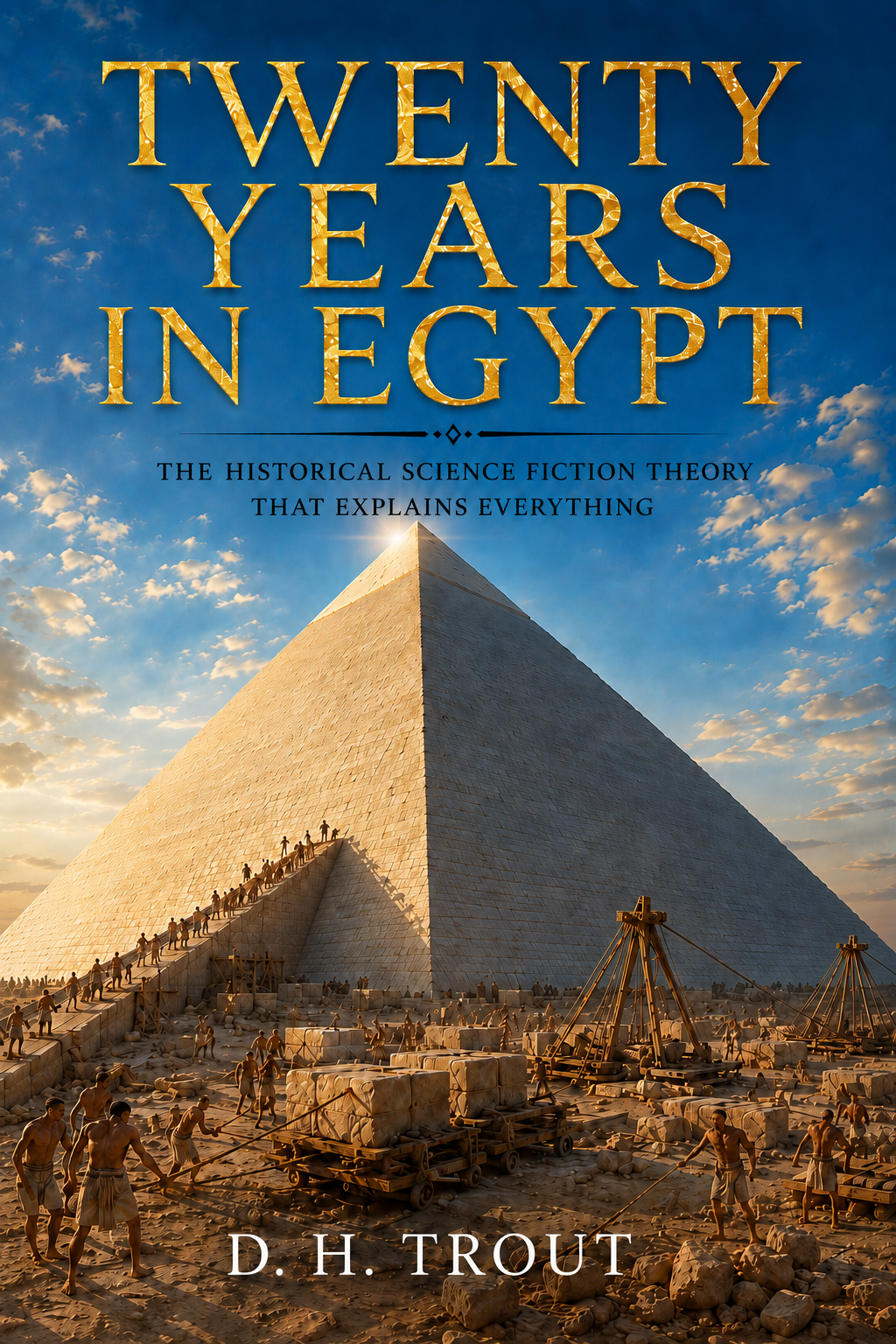
D.H. Trout ran every conventional method through the throughput equation. Ramps, sledges, rollers, seasonal labor. He gave the Egyptians every advantage. The math kept failing. So he kept adding capability until the math stopped failing — and looked at what he had added.
The result is a complete operational model: 27 vessels with designated roles — placement, transport, cutting, survey, maintenance. A fleet with shift schedules, redundancy, and maintenance downtime built into the arithmetic. Not a hand wave. Not a claim. A system, with numbers, that closes the throughput gap.
It is a work of historical science fiction. It does not claim to be what happened. It claims to be the only published model that survives its own arithmetic.
The fleet model closes the gap at every timeline. This is the theory that survives the arithmetic.
Further Reading
Whether you arrived here as a skeptic, a believer, or simply curious, these are the serious books on the Great Pyramid. Every perspective is represented.