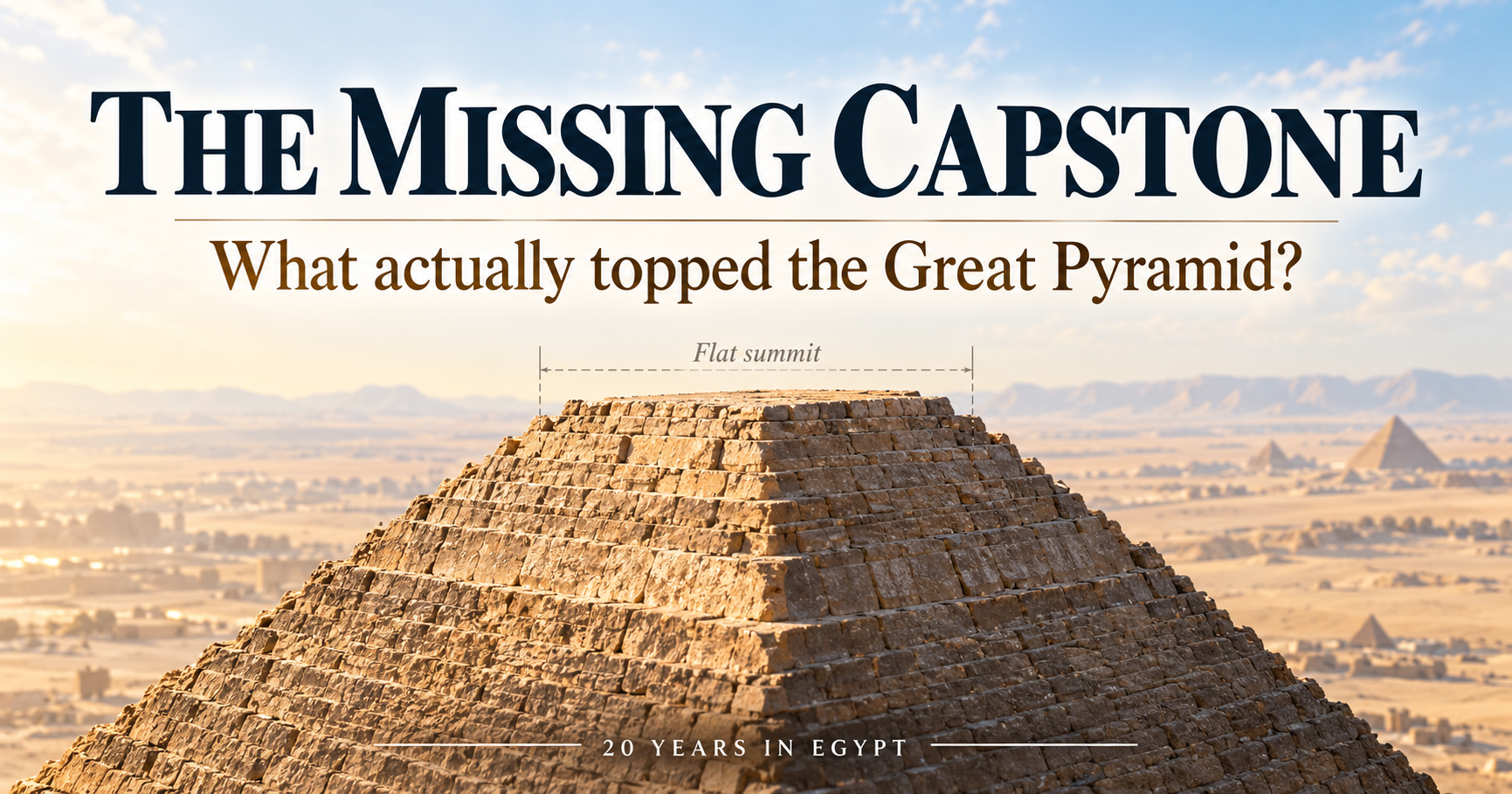
Modern illustrations of the Great Pyramid almost always show the same image: smooth white casing, a perfect point, and — often — a gleaming gold or electrum cap. It's the version on postcards, documentaries, and book covers, including some of ours.
The direct evidence for that image is much thinner than the confidence with which it gets drawn.
This page lays out what is actually known, what is historically reported, what is inferred by analogy to other pyramids, and what remains genuinely unresolved. We are not going to solve this one. Nobody has. We're going to show you why.
1. Pyramidions Were Real — and Khufu's Own Builders Used One
A pyramidion is the small, pointed capstone that finishes a pyramid's apex. These were real Egyptian architectural elements, and physical examples survive:
The Red Pyramid, built for Sneferu — Khufu's own father — at Dahshur. Fragments of its pyramidion were recovered in 1982 by the German Archaeological Institute in Cairo. Worth knowing: even with actual stone in hand, Egyptologists don't fully agree on its reconstruction. Published slope-angle estimates have ranged across several different figures. If a recovered pyramidion still generates disagreement among specialists, that tells you something about how much weight to put on any reconstructed one.
Amenemhat III's pyramidion, Middle Kingdom, found in 1900 and now in the Cairo Museum (JE 35133) — carved with solar imagery, a strong surviving example of what a finished royal pyramidion looked like centuries after Khufu.
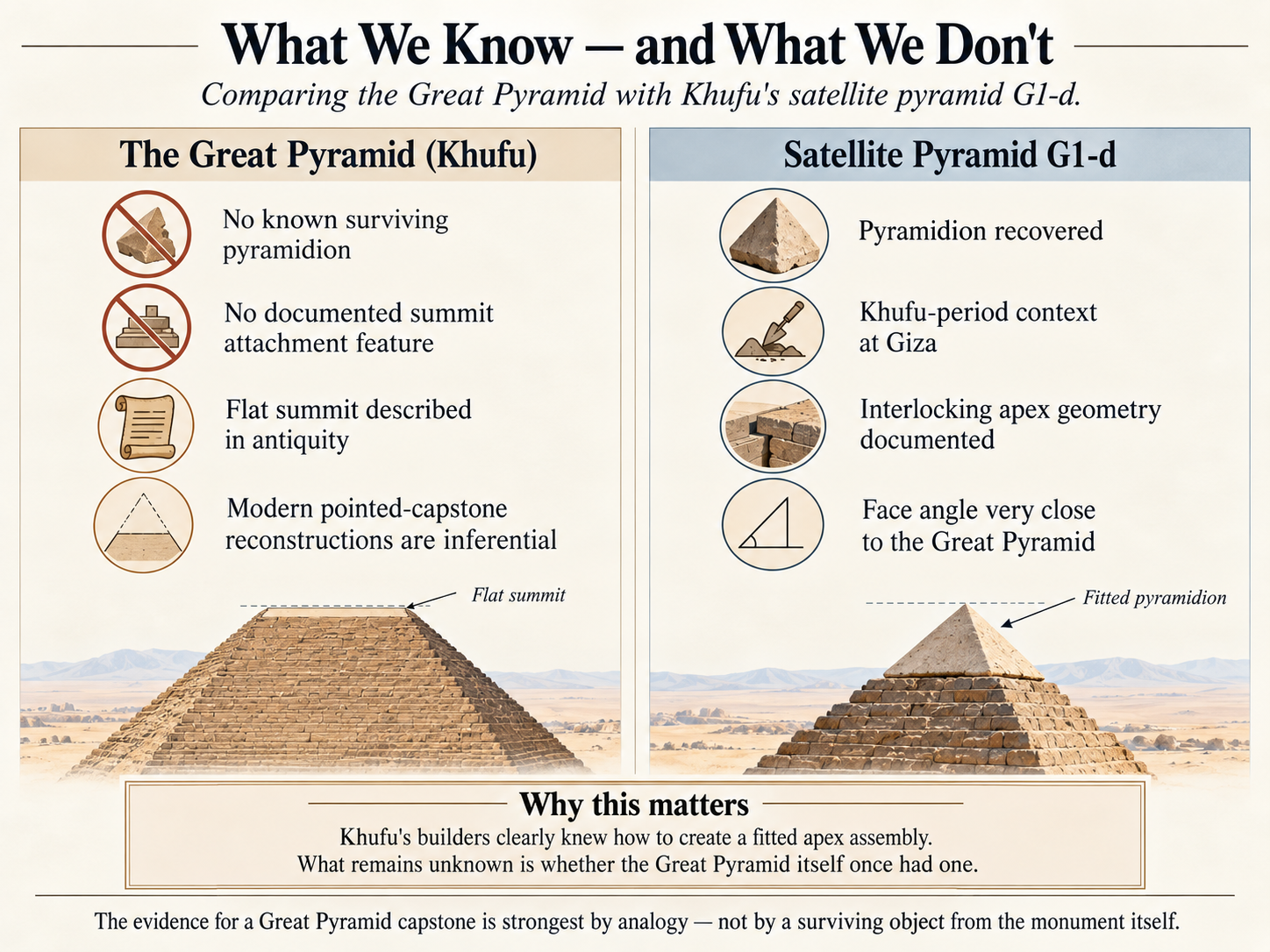
Most importantly: a pyramidion associated with Khufu's own satellite pyramid, G1-d, at Giza. This one matters more than the other two combined, because it belongs to Khufu's own building program and shares nearly the same face angle as the Great Pyramid itself. Specialist study of G1-d indicates the pyramidion and the stones below it were mechanically fitted together — a convex underside on the capstone nesting into a concave receiving surface on the course beneath it. That's a specially engineered apex assembly, built by Khufu-era craftsmen, at Giza, in the same generation as the Great Pyramid.
It proves the builders had the capability. It does not prove the same feature ever existed on Khufu's own monument.
A side note on a myth this page will not repeat: some popular claims trace the "gold-capped pyramid" idea to the so-called Inventory Stela, a monument inscribed centuries after Khufu — roughly 670 BC by its own language — which is why it's considered a later composition, not a contemporary record. That stela doesn't describe gold casing or a capstone at all. If you've heard the gold-capstone claim sourced to it, that sourcing doesn't hold up.
2. What We Do Not Have
No pyramidion securely attributable to the Great Pyramid itself has ever been recovered.
Nor do we have specialist documentation of a socket, a concave receiving bed, an anchoring feature, a peg hole, or any comparable attachment surface on the pyramid's surviving summit — the kind of feature that would directly prove a pyramidion was once fixed there.
That absence doesn't prove such a feature never existed. Several meters of the upper structure are gone. But the honest distinction is this: the Great Pyramid's capstone is reconstructed by analogy and architectural expectation — not from a surviving pyramidion or attachment feature belonging to the Great Pyramid itself.
3. Why the Popular Image Includes a Pyramidion — and Sometimes Gold
If there's so little direct evidence for the Great Pyramid's own capstone, where does the confident modern image come from? Not from nowhere. It comes from a real, well-documented Egyptian practice — just one that isn't proven to apply to this specific building.
The benben stone. At Heliopolis, ancient Egyptians venerated the benben, a sacred pointed stone linked to the primeval mound where creation began and to the sun god Ra. The pyramidion's shape, and one of its Egyptian names (benbenet), derive from this cult object. Pyramids and pyramidia were, from the start, solar architecture — Khufu's own pyramid was named Akhet Khufu, "Khufu's Horizon," a solar term. That religious context is exactly why later Egyptians gilded pointed monument-tops: gold, imperishable and sun-colored, was understood as Ra's own flesh.
Obelisks prove the practice — a related monument, gilded, and documented. Obelisks are pyramidion-topped pillars, architectural cousins of pyramids, dedicated to the same solar cult. Hatshepsut's surviving obelisk at Karnak, erected c. 1473–1458 BC, carries an inscription describing its pyramidion as worked in electrum (a natural gold-silver alloy) "of the best of all foreign lands," so that it would "illuminate the Two Lands like the sun disc." This isn't inference — it's the monument's own dedication text, and the obelisk still stands at Karnak today.
Because the solar cult is real, because gilded pyramidion-topped monuments are real and documented, and because the Great Pyramid was built for a king whose reign was steeped in the same solar theology, illustrators and documentarians have long assumed the Great Pyramid's own summit followed the same convention.
That's a reasonable guess, grounded in genuine Egyptian religious practice. It is still a guess: no inscription, no surviving fragment, and no Fourth Dynasty source ties gold or electrum specifically to Khufu's pyramid. The gilding is documented elsewhere in the tradition the Great Pyramid belongs to — not on the Great Pyramid itself.
Source on the Hatshepsut obelisk inscription: James Henry Breasted, Ancient Records of Egypt, Vol. II, §§308–319 (translating Urk. IV, 356–369)
4. The Reconstruction Gets More Confident Exactly Where the Evidence Gets Thinner
The familiar modern image layers three claims on top of each other, and they are not equally supported:
| Claim | Status |
|---|---|
| Smooth, fine white Tura limestone casing | Known — physically documented |
| A finished pyramidion at the apex | Plausible — supported by comparanda like G1-d, not by direct Great Pyramid evidence |
| A gold or electrum capstone specifically | More speculative — direct evidence for metal-covered pyramidions in the Fourth Dynasty is limited; stronger evidence for electrum casing appears later in Egyptian history |
We know progressively less as we approach the final few meters of the Great Pyramid, yet modern reconstructions often become most confident precisely where the physical evidence becomes thinnest.
5. The Oldest Eyewitness: Diodorus Siculus, c. 60 BC
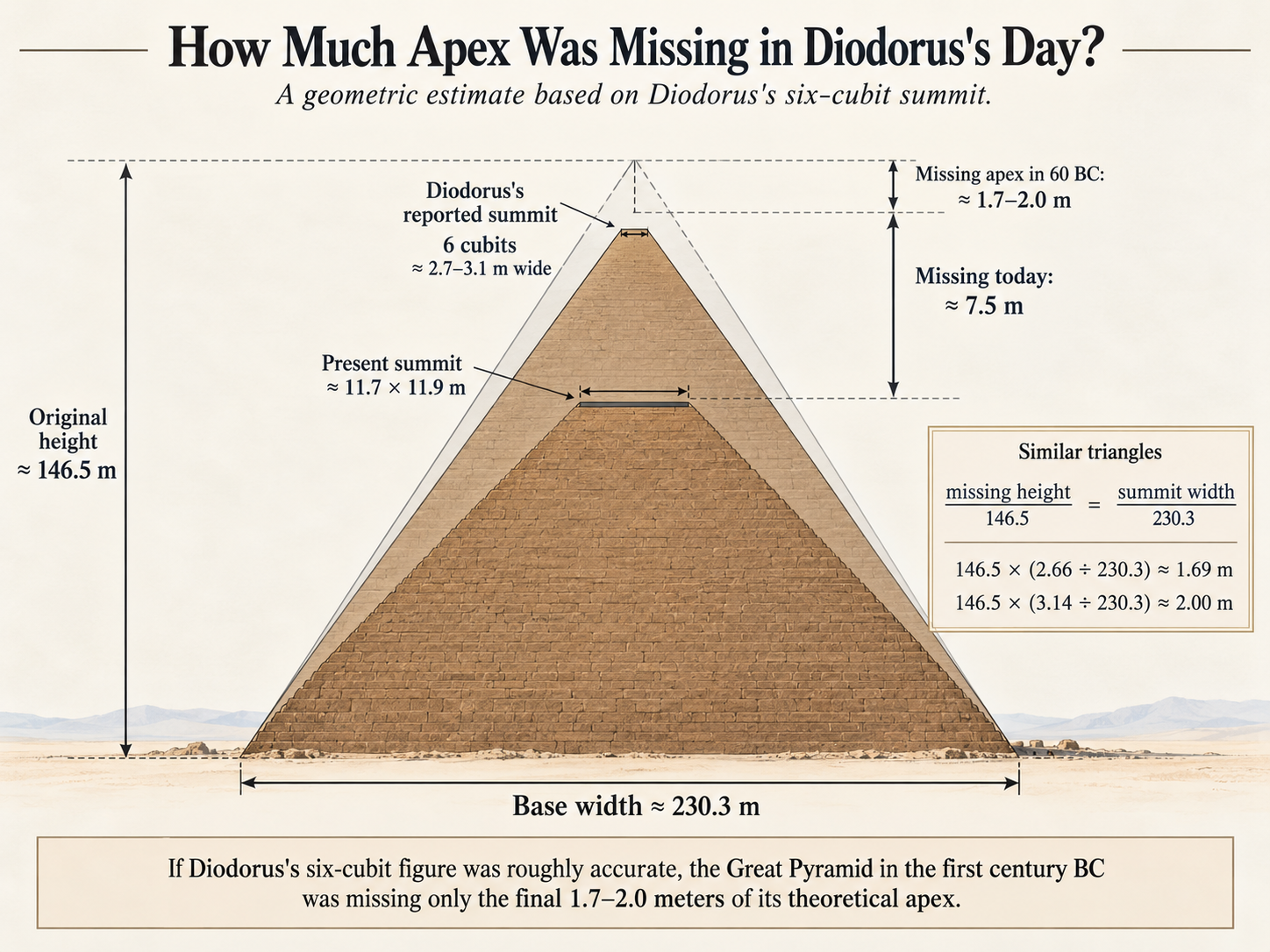
Writing in the first century BC — roughly 2,500 years after construction — the Greek historian Diodorus Siculus described the Great Pyramid tapering to a summit where each side measured six cubits. He doesn't claim to have climbed and measured it personally; treat this as a reported ancient dimension, not a modern survey.
The detail that matters: by roughly 60 BC, the Great Pyramid was already being described as having a small flat summit — not a pointed apex.
Primary text: Diodorus Siculus, Library of History, Book I
6. Show the Work: What Six Cubits Means at Scale
Using the reconstructed original dimensions of the Great Pyramid — height approximately 146.5 m, base width approximately 230.3 m — a summit platform's width scales to a missing-apex height by simple similar triangles:
missing apex height = 146.5 × (summit width ÷ 230.3)
At a Greek cubit (≈0.444 m), six cubits ≈ 2.66 m, giving a missing apex of roughly 1.7 m.
At the longer Egyptian royal cubit (≈0.524 m), six cubits ≈ 3.14 m, giving roughly 2.0 m.
So if Diodorus's summit dimension is even approximately right, the pyramid he saw may have been missing only its final 1.7–2.0 meters (roughly 5½–6½ feet) — not the much larger gap we see today.
Diodorus's other reported measurements aren't modern-survey accurate, so treat this as a matter of scale, not precision: he appears to describe a small summit platform, close to the theoretical apex — not the wide, flattened top the pyramid has now.
7. Twelve Centuries Later: ʿAbd al-Laṭīf al-Baghdādī, c. AD 1200
The Baghdadi physician and traveler ʿAbd al-Laṭīf al-Baghdādī visited Egypt around AD 1196–1200. His account reports that a man climbed the Great Pyramid and measured the summit at approximately eleven cubits per side — roughly 5 meters, depending on which cubit is assumed. This appears to be a reported measurement rather than one ʿAbd al-Laṭīf took himself.
Primary source: Silvestre de Sacy's 1810 edition — Library of Congress
Modern discussions of this account also indicate substantial exterior casing still remained at the time. That gives us a second fixed point: more than twelve centuries after Diodorus, the pyramid was still described as having a summit platform, while much of the casing was apparently still in place.
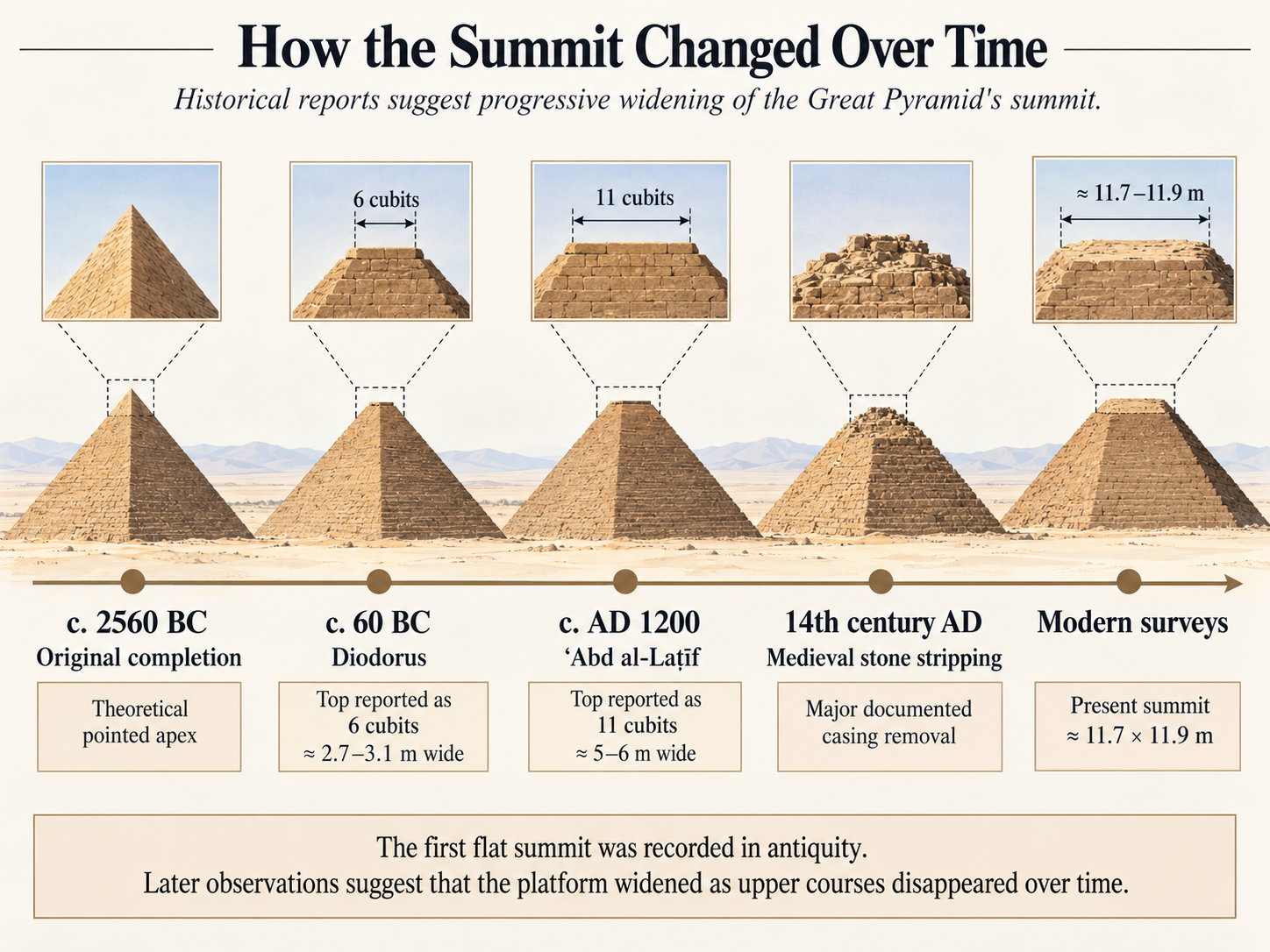
8. The Summit Widened, One Century at a Time
| Date | Source | Reported / Measured Summit |
|---|---|---|
| c. 60 BC | Diodorus Siculus | ~6 cubits (~2.7–3.1 m) |
| c. AD 1200 | ʿAbd al-Laṭīf al-Baghdādī | ~11 cubits (~5–6 m) |
| 1865 | Piazzi Smyth | ~10.2 m |
| Modern survey | Kawae et al. | ~11.7 × 11.9 m |
Diodorus and ʿAbd al-Laṭīf are historical reports, filtered through ancient cubit conventions and secondhand measurement. Smyth and the modern survey are direct measurements. They shouldn't be read with equal precision — but the trend across all four is the same direction, and it is consistent with the top of the pyramid being lost progressively, over many centuries, rather than all at once.
9. What's Missing Today
Using the modern summit width of roughly 11.8 m, the same similar-triangle math gives:
146.5 × (11.8 ÷ 230.3) ≈ 7.5 m
Today, roughly the top 7 to 8 meters of the theoretical full pyramid are gone. That figure lines up with the standard difference cited between the pyramid's reconstructed original height and its present height.
But that condition developed over time. It should not be projected backward onto Diodorus — his six cubits describe a far smaller gap than the one we see today.
10. The Timing Problem: This Predates the Well-Documented Medieval Stripping
The major, well-documented removal of the Great Pyramid's casing stone happened much later than Diodorus:
Some earlier stone-robbing may have occurred, possibly even in antiquity. The best-documented medieval phase includes casing apparently still visible into the early 14th century, pyramid stone in use in Cairo construction around AD 1356 under Sultan Hasan, and eyewitness reports by AD 1395 of workers actively removing casing stone.
This creates a real problem for any tidy explanation: the flat summit Diodorus described around 60 BC cannot be explained by the well-documented medieval quarrying — that stripping happened well over a thousand years later. Whatever removed the first small portion of the apex happened much earlier, and it isn't documented at all.
11. Two Possibilities, and We Can't Choose Between Them
Possibility One — no pyramidion was ever installed. The Great Pyramid may have been deliberately finished with a small summit platform, or left with an unfinished apex. If so, the standard modern image of a pointed, capped pyramid is simply wrong for this particular structure.
Possibility Two — a pyramidion and upper courses once existed, and were lost early. A capstone may have been placed originally and removed or destroyed not long after, with the surrounding upper courses continuing to erode across the next two thousand years. The G1-d evidence — a real, mechanically engineered apex assembly, built by Khufu's own craftsmen, at Giza, in his own era — makes this entirely plausible. A related variant: the Great Pyramid may have used a special apex assembly comparable to G1-d's, with the entire assembly gone before the classical period.
The evidence available today does not let us choose confidently between these.
12. The Question This Leaves Us With
By around 60 BC, Diodorus was already describing a small, flat summit — more than a thousand years before the best-documented stripping of the pyramid's casing. And in the same passage, he describes the monument as remarkably well preserved otherwise.
So: was the final apex removed in deep antiquity? Was it never installed at all? Or was the Great Pyramid's summit designed differently than the standard reconstruction assumes?
We don't know.
The evidence tells us that the summit changed. It does not yet tell us what was there first.
Pyramidions were real. Khufu's own builders used one nearby. But no capstone from the Great Pyramid itself survives, and by the first century BC the monument was already being described with a small, flat summit.
Later observers saw that summit grow wider as more of the upper pyramid disappeared.
Somewhere between Khufu and Diodorus, the history of the final apex was lost.
Whether that missing piece was once a conventional pyramidion, a specially engineered apex assembly, or something else entirely remains an open question.
That is the mystery.