The Serapeum of Saqqara is one of ancient Egypt's strangest surviving structures: a network of underground galleries holding two dozen monolithic granite boxes, some weighing close to 100 tons, built for the burial of bulls. Discovered in 1851, it is still not fully explained a century and three-quarters later — and it has become a fixture of online "ancient mystery" content, which has left it carrying some genuinely confused numbers alongside some outright fabricated ones.
This page separates what is documented from what is merely repeated online — and flags, by name, the one claim that gets the most traffic and the least sourcing.
1. What the Serapeum Actually Is
The Serapeum is the communal burial place of the Apis bulls — animals worshipped at Memphis as the living embodiment of the god Ptah, and, after death, identified with Osiris. Egyptian priests maintained the Apis cult for roughly 1,300 years, from the New Kingdom into the Ptolemaic period; each bull, on its death, was mummified with the same ceremony given to a king and interred in its own chamber.
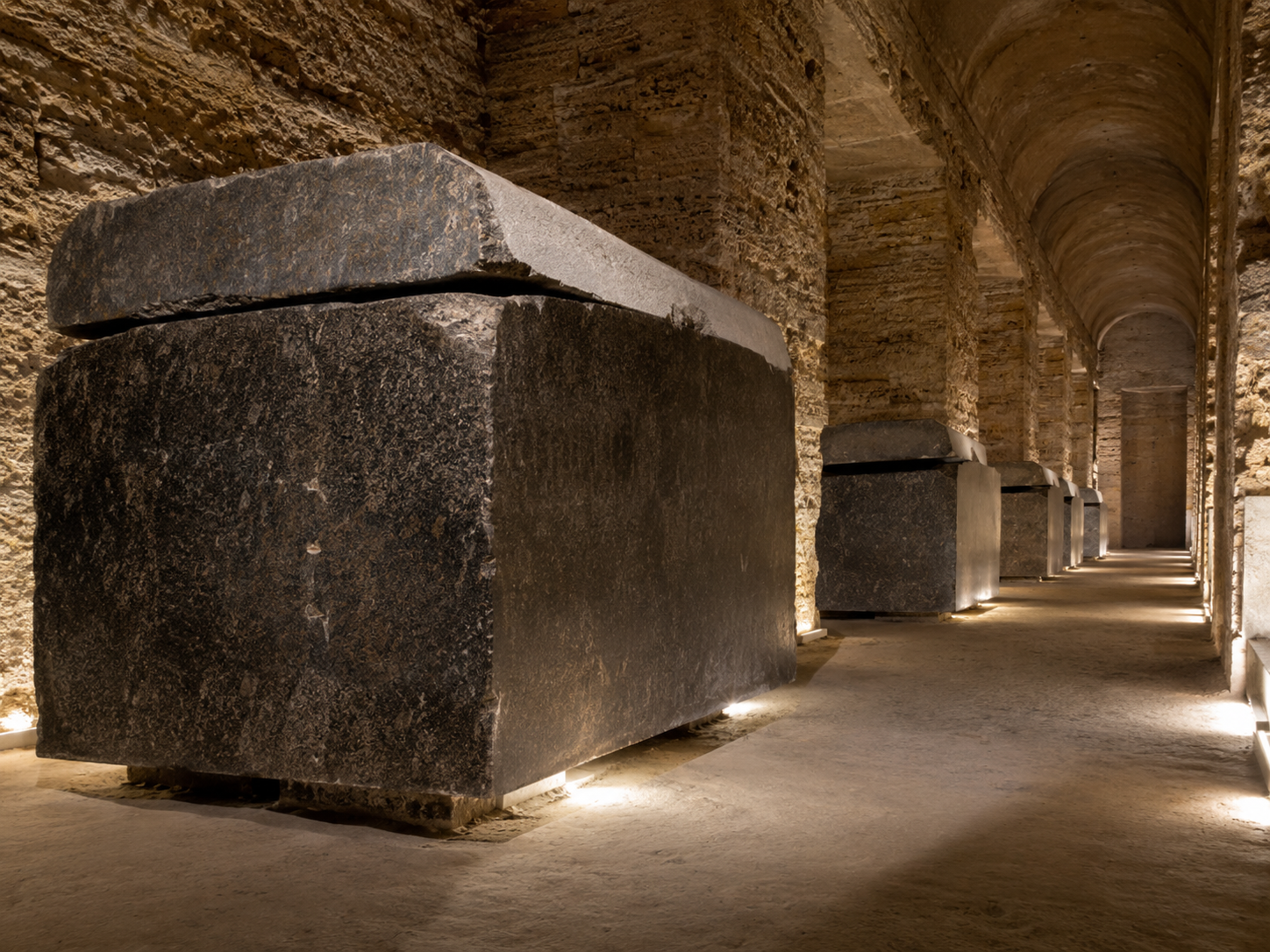
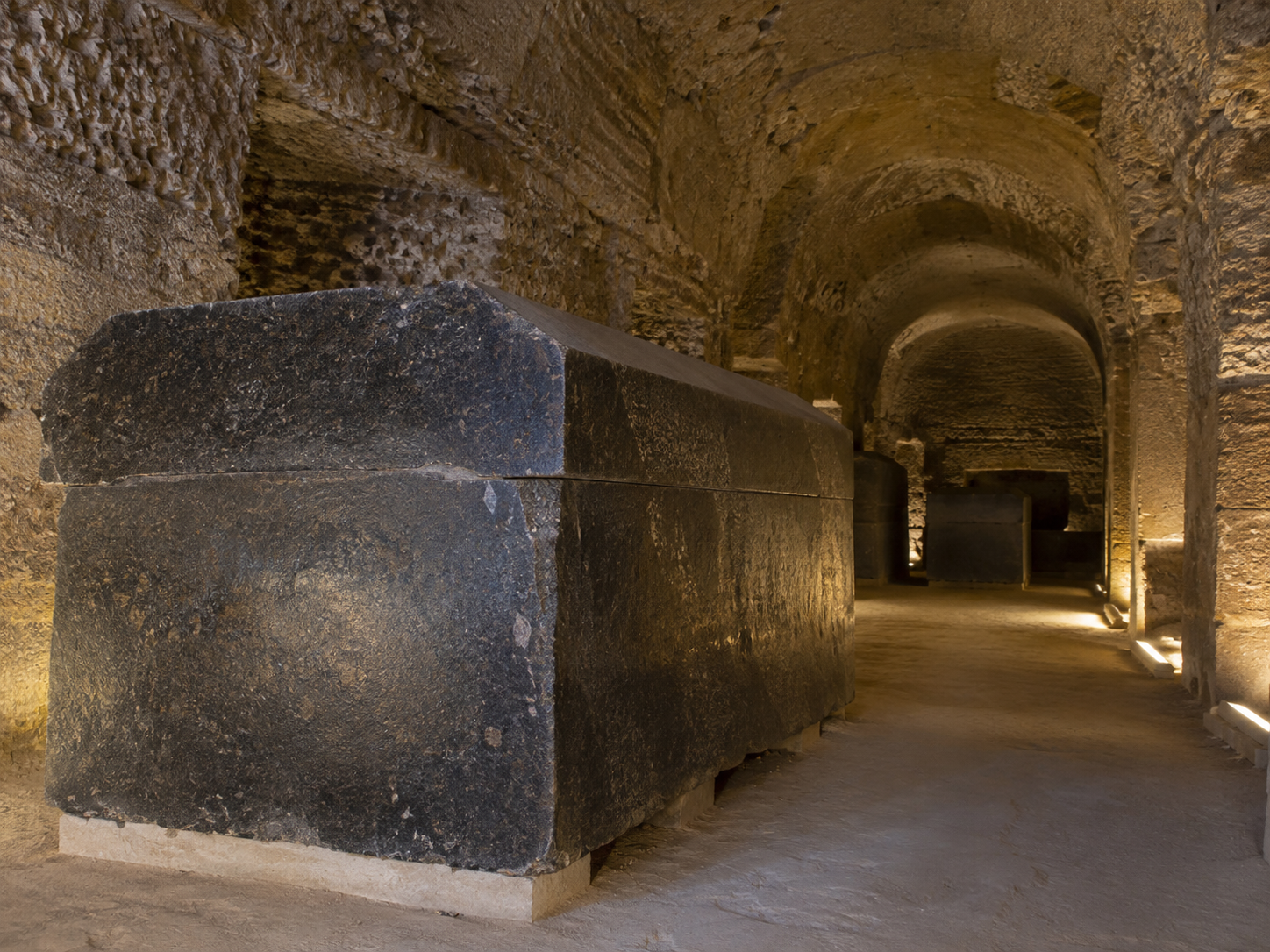
The burial complex sits west of Saqqara's Step Pyramid, cut into the bedrock rather than built above it: a network of galleries and side-chambers connected by corridors, with the main gallery — sometimes called the Greater Vault — running roughly 350 meters, lined on both sides with more than thirty niches.
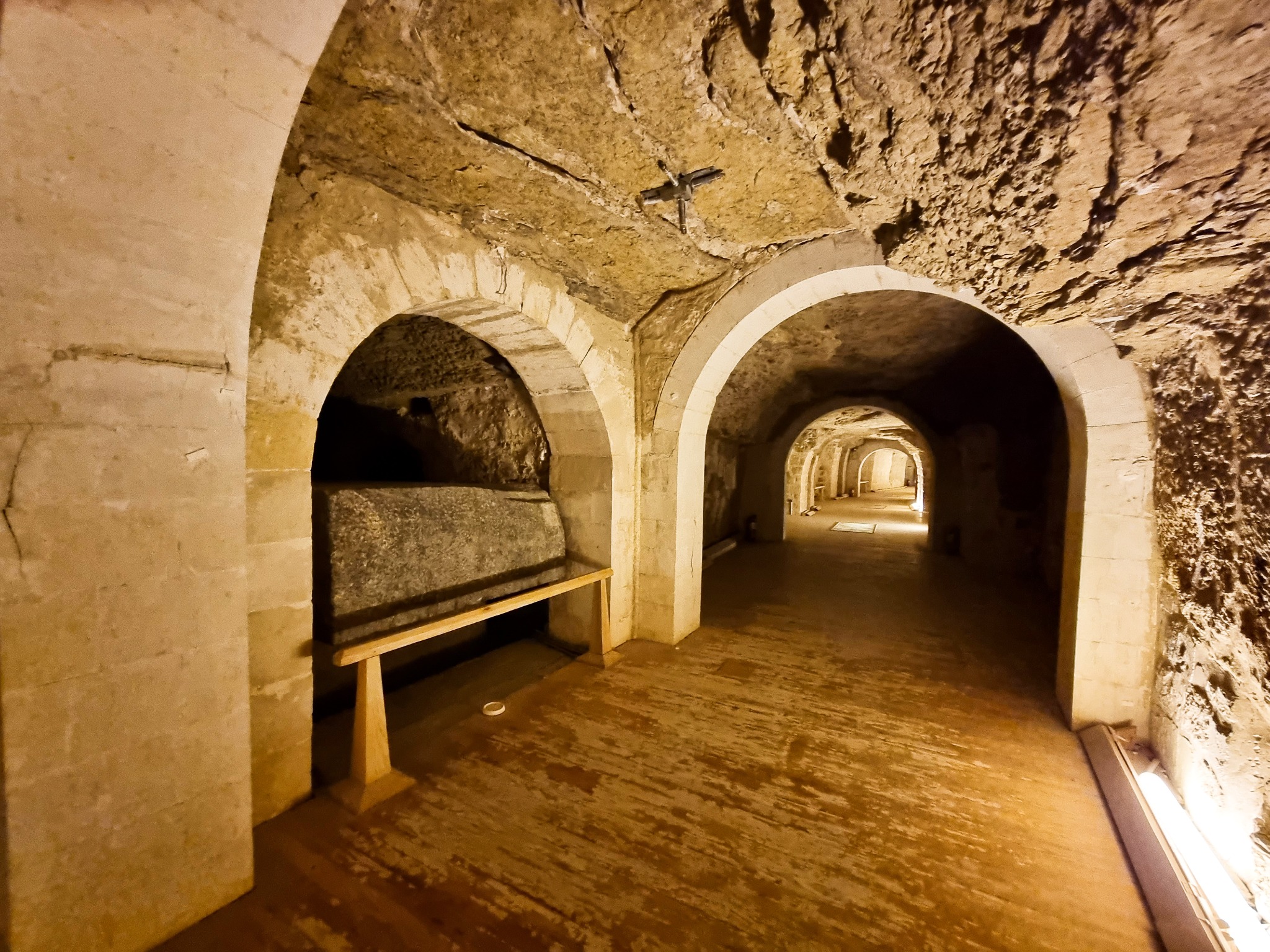
2. The Discovery: Auguste Mariette, 1850–1851
The site had been lost to the sand for centuries when the French Egyptologist Auguste Mariette, working from a passage in Strabo describing an avenue of sphinxes leading to the Serapeum, spotted the head of one such sphinx protruding from a dune in 1850. Digging with a crew of workmen, he uncovered dozens more sphinxes along a buried processional way, and on November 12, 1851, broke through a sealed, rubble-packed entrance into the underground galleries themselves.
The monumental sarcophagi visible in the later galleries had already been opened and robbed in antiquity; Mariette did not find the famous granite boxes intact with their original burials.
3. The Apis Bull: Why a Bull Got a King's Burial
Before the boxes themselves make sense, the animal inside them has to. That "all this, for a bull?" reaction is the natural one — and the Egyptians had a specific, coherent answer to it.
What made a bull an Apis bull. There was only one recognized Apis bull alive at a time, kept near the Temple of Ptah at Memphis and believed to be the living manifestation of the god Ptah, the city's creator-god and patron of craftsmen. When it died, priests sought another calf bearing the prescribed markings, which then became the new living manifestation of Apis.
How one was identified. According to the Greek historian Diodorus Siculus, when the reigning bull died, priests fanned out across Egypt looking for a calf marked exactly like its predecessor. Diodorus and, separately, Herodotus describe a specific checklist: a white triangle on the forehead, a solar-disc-and-vulture (or eagle-shaped) marking on the back, a scarab-shaped mark under the tongue, and particular coloring. A calf that matched wasn't just approved — its discovery was treated as a major national religious event, announced across the country.
Why it was sacred. Apis predates even Ptah's association with it — the bull cult goes back to early fertility worship, where the animal's vitality was read as a sign of the land's own fertility. By the time the cult reaches the New Kingdom, that older bull-god has been folded into Ptah's identity, so the living Apis was simultaneously a fertility symbol, a creator-god's earthly body, and — on death — the god Osiris, lord of the afterlife. Few things in Egyptian religion carried that much theological weight in one animal.
How it was treated while alive. The bull lived in its own compound within the Temple of Ptah at Memphis, attended by priests and consulted as an oracle. The Greek geographer Strabo, writing in the 1st century BC, describes it being released daily into a courtyard where the public could watch — part worship, part spectacle, with one recorded ritual allowing women to lift their skirts before the bull as a fertility rite. It also had a direct, public role in kingship: at the Heb-Sed festival, a royal jubilee held to renew a pharaoh's rule, the Apis bull is recorded walking beside the king as a visible sign of divine approval, and an older ceremony known as the "Running of Apis" — attested from the earliest dynasties — had the bull ritually run through the temple grounds to symbolically renew the land's fertility.
What happened after it died. Its death triggered public mourning and a mummification process that mirrored royal human burial almost exactly, running on the order of seventy days: viscera removed and set aside, the body dried with natron, wrapped in linen, plastered and painted, fitted with a gilded solar disc between the horns, then processed to the Serapeum on a sledge under a gilded canopy, accompanied by imagery of the goddesses Isis and Nephthys. An "Opening of the Mouth" ceremony — the same ritual performed on human pharaohs' mummies to restore the senses for the afterlife — was carried out at the Serapeum entrance before the bull was sealed into its sarcophagus underground. In death, the bull's identity shifted from Ptah's living body to Osiris himself — Osiris-Apis, a merged identity later Greek settlers rendered as "Serapis." That is the literal etymology of "Serapeum": the place of Osiris-Apis.
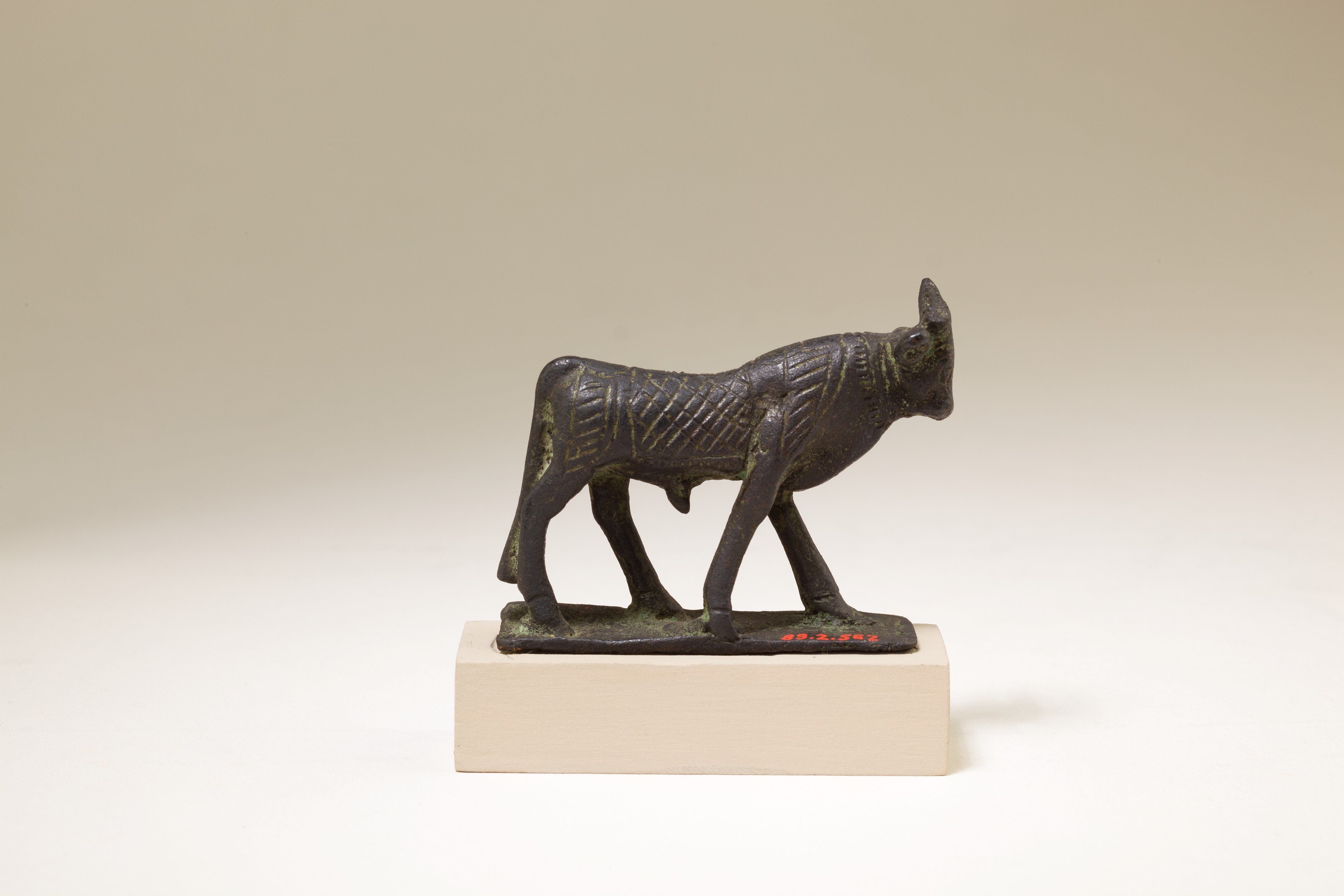
This is the piece that resolves the "all this, for a bull?" reaction. The Egyptians were not burying an animal — by their own theology, they were burying a living, divinely-installed embodiment of a creator god who had, at the moment of death, become the specific god who ruled the afterlife. A pharaoh's own legitimacy was bound up in the same symbolism: the bull walked beside the king at his jubilee as proof of divine favor, and a king's authority to rule was itself framed as descending from the same web of gods the Apis represented.
That's also why the cult had real political stakes centuries later, long after any purely religious sentiment might have faded. Foreign rulers who took the Egyptian throne — the Persian king Cambyses II, and later the Ptolemaic kings — are recorded personally participating in Apis funerals and cult maintenance specifically to establish their own legitimacy as pharaoh. Ptolemy I went further, building the Greco-Egyptian worship of Serapis directly on the cult's existing prestige. Giving the Apis a burial on the scale of a king's wasn't excess for its own sake — by Egyptian religious logic, it effectively was a king's burial, and every ruler with something to prove had a direct interest in being seen doing it properly.
Burials at the site ran, with interruptions, from around the reign of Amenhotep III in the New Kingdom to roughly AD 170 in the Roman period — construction of the connected gallery system usually credited to Ramesses II, with the Greater Vault's major expansion under Psamtik I of the 26th Dynasty.
Sources: Herodotus and Diodorus Siculus on bull markings, selection, and the Heb-Sed appearance (as translated and discussed in Isabelle Kingo, "The Apis Cult from the New Kingdom to the Ptolemaic Period," BA thesis, Uppsala University, Dept. of Archaeology and Ancient History, 2020); Joshua J. Mark, "Apis," World History Encyclopedia, on the Running of Apis and the Heb-Sed connection to kingship; Nenad Markōvić (Czech Institute of Egyptology, Charles University in Prague), on the Place of Apis sanctuary at Memphis, Journal of Ancient Egyptian Architecture.
4. Twenty-Four Boxes in the Greater Vault
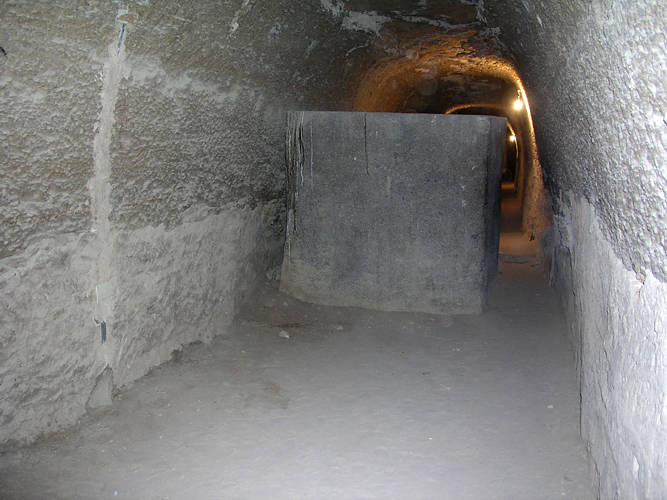
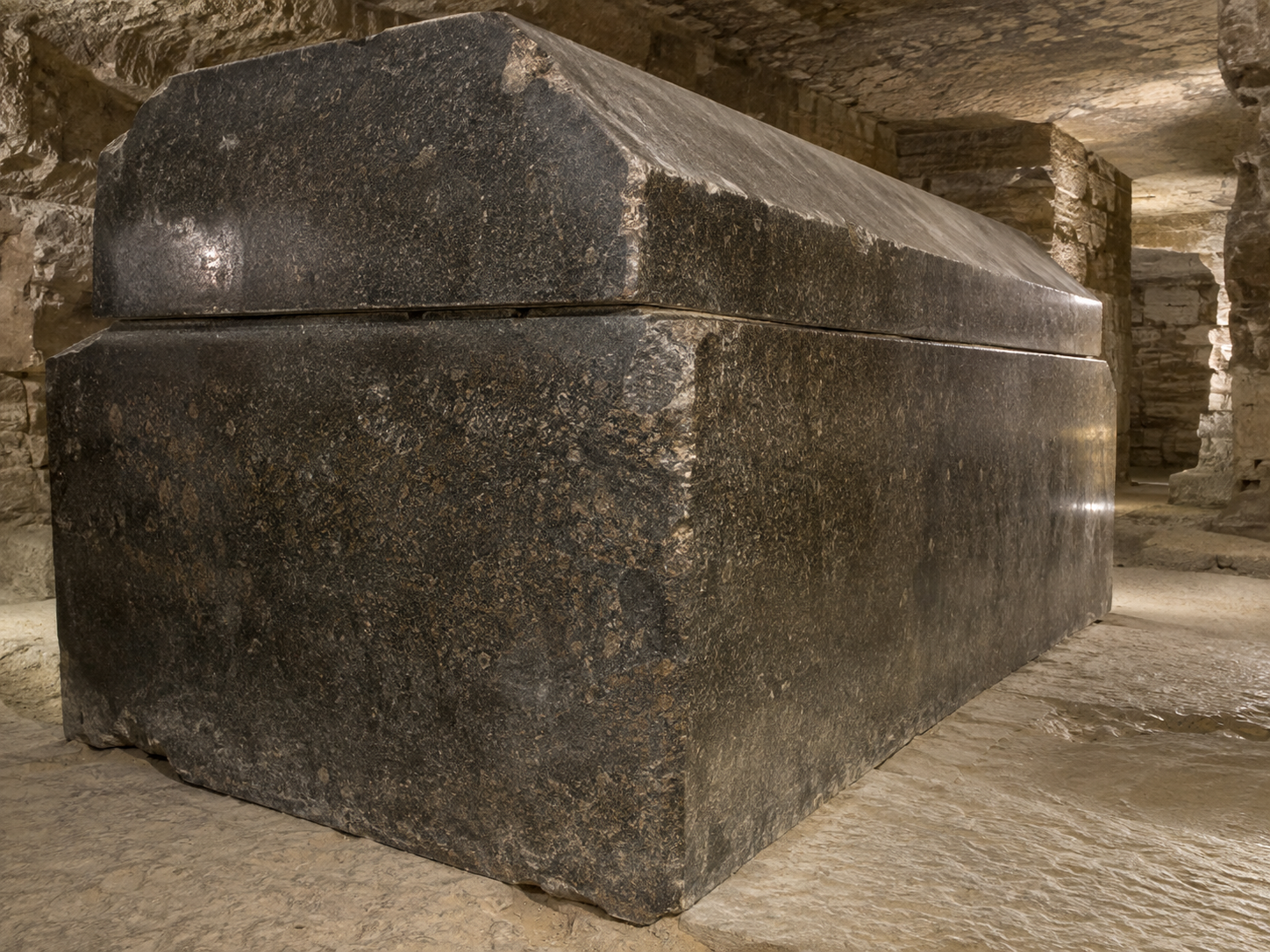
Casual accounts of the site vary widely on the count, with figures anywhere from single digits to several dozen circulating online. What's actually documented is more specific than either extreme: the Greater Vault holds twenty-four massive granite sarcophagi set into its side niches and main corridor — twenty-two of them centered squarely in their niche, two noticeably off-center, for reasons no inscription explains.
Each box is cut from a single block of granite: roughly 4 meters long, a little over 2 meters deep, and more than 3 meters tall including the lid. Estimates for the weight of box plus lid together run from about 60 tons to as much as 100 tons, depending on the source and the individual sarcophagus; the lids alone are commonly cited around 30 tons.
5. Reconciling "24" with the Higher Numbers You May See Cited
Some sources describe Mariette recovering "more than sixty" Apis sarcophagi in total, which looks like a contradiction of the "24" figure until you account for the site's full history. The Apis cult ran for roughly 1,300 years, and burial practice changed considerably over that span. Earlier burials — going back toward the New Kingdom — used individual, smaller tombs with plainer wooden or stone coffins; it was only later, generally associated with the expansion of the galleries under the 19th and 26th Dynasties, that Apis burials were consolidated into the connected corridor system and given the enormous polished granite sarcophagi that dominate the site today.
The twenty-four giant granite boxes are the ones visible in the Greater Vault and the ones almost every photograph and video shows. The higher total counts everything Mariette catalogued across the site's entire multi-century history, including earlier and much smaller burials that don't resemble the famous granite boxes at all. We flag this because the discrepancy is real in the source material, not a case of one side being simply wrong.
6. The Precision Claim — and Where It Actually Comes From
What is genuinely documented, and visible to any visitor: the interior walls of the granite boxes are flat, the internal corners are square, and the surfaces are highly polished for a stone this hard. That much is not in dispute and doesn't require any exotic explanation — granite polishing and precise interior cutting are attested elsewhere in Egyptian stonework of the same general era, achieved with copper tools, abrasive sand, and a great deal of skilled labor and time.
"The tolerances" almost certainly refers to a much more specific and much less well-sourced claim that circulates widely online: that the interior surfaces are flat to within about one micron (roughly 1/25,000 of an inch), a tolerance associated with modern precision machining rather than hand tools.
That specific figure traces back to the American engineer and author Christopher Dunn, most associated with his book Lost Technologies of Ancient Egypt, who has stated the boxes were finished to a flatness within roughly 1.27 microns. It is repeated across dozens of "ancient mystery" articles and videos, almost always without a citation trail behind it.
We could not locate a peer-reviewed publication, a documented measurement methodology, or an independent replication of that figure by a metrologist, conservator, or Egyptologist with access to the site. That doesn't make the claim false — but a single, non-peer-reviewed number, repeated for two decades without independent verification, is not the same thing as an established scientific measurement. We're flagging it as exactly what it is: a specific, attributable claim, not a settled fact, and we'd treat any video or article that states it as plain fact with real skepticism.
7. The Fringe Theory You'll Also Run Into
Once a claim like the micron figure is in circulation, it tends to attract explanations that go well beyond "skilled ancient stoneworkers." One example making the rounds: a proposal, credited to writer Konstantin Borisov, that the sealed granite boxes functioned as pressure vessels for generating electricity — fermenting grain inside to build gas pressure, which stresses quartz crystals in the granite (the piezoelectric effect) enough to build a voltage and, at sufficient strength, ionize the surrounding air into a visible glow.
This is a physics-flavored narrative, not a documented finding. It has no supporting residue evidence (no fermentation byproducts, no wiring, no scorching consistent with a power installation), no ancient text describing such a use, and it isn't advanced by anyone with a background in Egyptology or electrical engineering publishing through ordinary channels. We include it here only because it's one of the things a viewer following this topic online is likely to run into next, and because our standard on this site is to name a claim and its source rather than pretend it doesn't exist.
8. What We Actually Know, in One Place
| Claim | Status |
|---|---|
| Underground necropolis built for Apis bull burials, discovered by Mariette in 1850–51 | Known |
| Apis bulls selected by specific markings, worshipped as Ptah's manifestation, mummified over ~70 days | Known — classical sources + modern Egyptology |
| Twenty-four monolithic granite sarcophagi in the Greater Vault, roughly 60–100 tons each | Known |
| Higher "60+" sarcophagi counts reflect ~1,300 years of burials, including smaller/earlier ones | Plausible / explained |
| Interior surfaces are flat, square, and highly polished | Known |
| Flatness measured to ~1 micron tolerance | Unresolved — sourced to one author, not independently verified |
| Boxes functioned as electrical/piezoelectric generators | Speculative |
The Serapeum doesn't need an exaggerated headcount or an unverified tolerance figure to be remarkable. Twenty-four single-block granite sarcophagi, some approaching 100 tons, moved and set into hand-cut underground corridors for the burial of bulls, is already a serious feat of Late Period engineering and logistics — fully within the documented capabilities of Egyptian stoneworkers, and fully worth the attention it gets.
The "one-micron" precision claim may turn out to be accurate. It may also turn out to be an approximation that hardened into a factoid through repetition. Until someone publishes the measurement with a method attached, the honest answer is that we don't know which.
Real mystery, real engineering — just not the mystery most videos are selling.